
The mountain as a sentinel for wildlife.
La Rhune rises to 900 metres at the heart of a Natura 2000 site. Our main relay radiates at just 20 mW there, a hundred times less energy than a smartphone. An infrastructure this discreet opens up a new path: supporting naturalist science and wildlife protection, without disturbing anything.
A network that listens as much as it transmits.
Long-range radio networks aren't only good for sending messages between people. For about ten years, teams of researchers (from the CNRS to INRAE, via the European LIFE programme) have been experimenting with miniaturised LoRa tags to track wildlife without disturbing it.
A griffon vulture soaring at 2,500 m above La Rhune sees its radio horizon stretch beyond 180 km. With a fixed relay on the ridge, a 20-gram tag is enough to transmit its position in real time, no power-hungry GPS, no costly satellite link: just LoRa, discreet, frugal, effective.
LarrunKonnect doesn't claim to be a scientific programme. But our infrastructure, already in place across the massif, could form the radio backbone of a partnership with Hegalaldia, LPO Pyrénées-Atlantiques, or the Regional Nature Park teams. Free of charge, passively, without a single extra screw in the rock.
“The tagged bird itself becomes a mobile node of the network, reporting its coordinates every time it passes over a fixed relay, with no physical link at all to human infrastructure.”
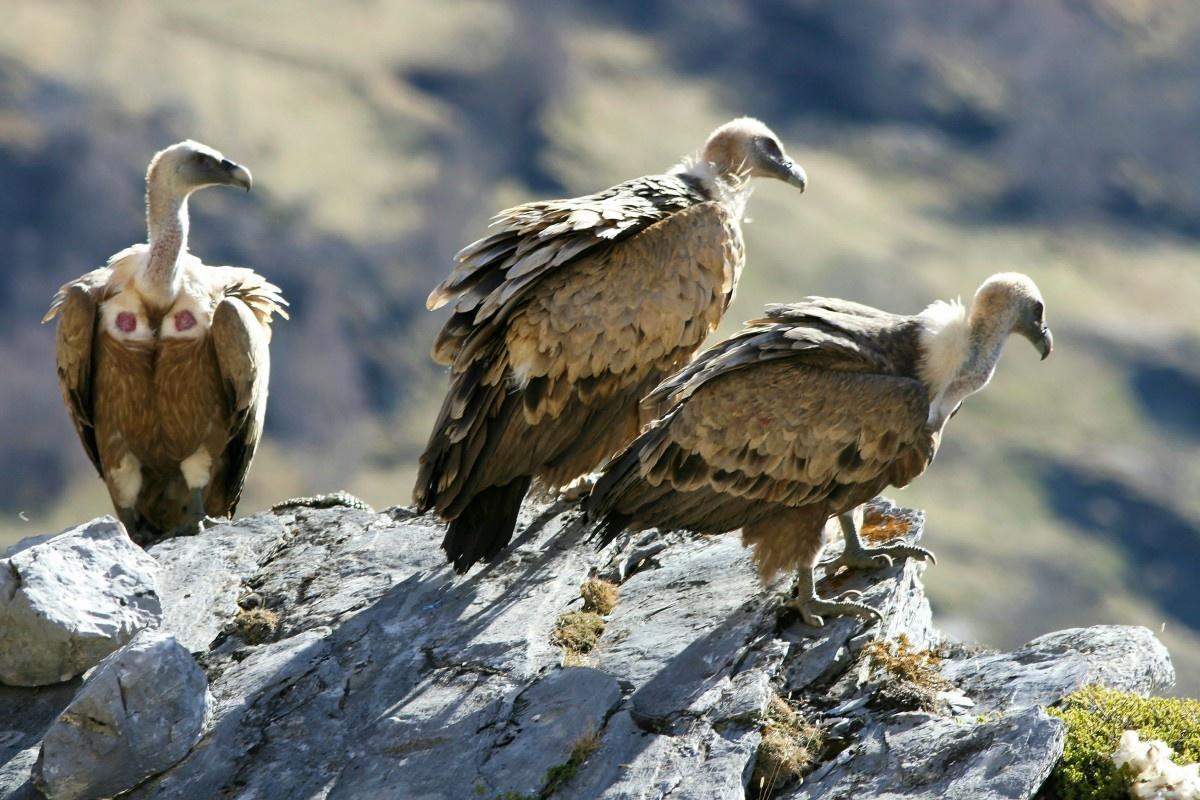
Vultures, bearded vultures, kites: sentinels of the ridges.
Pyrénées-Atlantiques is home to one of the finest diversities of soaring raptors in Europe. These species (some of them near-threatened) could benefit from non-invasive LoRa tracking, without repeated capture or costly satellite links.
Griffon vulture
The griffon vulture is the emblematic great soaring bird of the Pyrenees. Its thermals carry it up to 3,000 m in altitude, giving it a range of several hundred kilometres per day of flight. It nests in colonies on limestone cliffs, from the Basque side of Spain to Ossau and beyond.
A 22 g LoRa tag (under 3% of body weight, the recommended scientific threshold) doesn't alter its flight behaviour. It transmits every 5 to 10 minutes, drawing under 100 μA on standby, giving it a battery life of 6 to 12 months on a single lithium cell.
Bearded vulture
The bearded vulture, the only vertebrate whose diet is 70–90% bone, came close to extinction in Europe. The Pyrenees were its last continental refuge before reintroduction programmes began in the Alps. It patrols subalpine areas in slow, silent glides, hugging the ridgelines.
A protected species under Annex I of the Birds Directive, any tag requires a prefectural exemption. With devices under 15 g validated by programmes such as LIFE Rupis, a mobile LoRa node offers near-continuous transmission whenever the bird comes within range of a fixed ridge relay, like the one on La Rhune.
Red kite
A partial migrant, the red kite follows the Pyrenean corridor in autumn. Sharply declining in France, it benefits from national recovery plans. Its light weight makes it an ideal candidate for ultra-light LoRa tags (under 3 g) connected to a relay network like LarrunKonnect.
Real-time passage data could feed migratory phenology databases (LPO, Ornithos) and trigger presence alerts in areas at risk of collision with wind turbines or high-voltage lines.
Dolphins and great cetaceans of the Bay of Biscay.
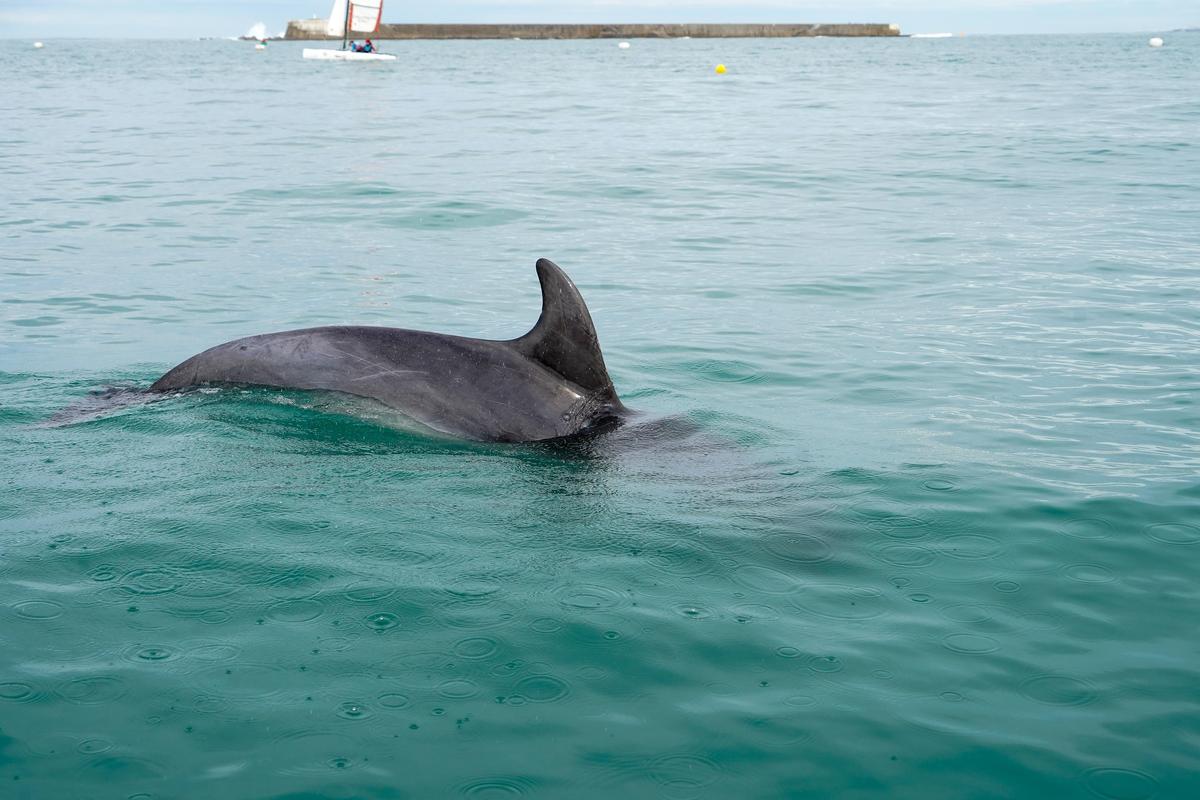
The Bay of Biscay is one of the richest seas in Europe for cetacean diversity. The bay of Saint-Jean-de-Luz, a few kilometres from our coastal relay, is a favoured passage corridor for bottlenose dolphins, common dolphins, and, more rarely, offshore sperm whales.
Acoustic buoys and coastal sensors deployed by the Pelagis Observatory (CNRS / La Rochelle Université) detect cetacean passages through their vocalisations. To be useful in real time, the alerts these sensors generate need a frugal, robust data link independent from mobile networks , which cover exposed coastal areas poorly.
A LarrunKonnect node placed on the Basque coast (Socoa, Hendaye, cap du Figuier) could relay these alerts within seconds to observers on shore: no SIM, no subscription, with unlimited solar autonomy. The harbour porpoise (Phocoena phocoena), classified as critically endangered in the Bay of Biscay, would be the first to benefit from this early-warning system.
A coastal hydrophone detects sperm whale clicks at 2am. It triggers a LoRa frame → Socoa relay → La Rhune relay → notification to researchers and harbour offices. Cost of the interface node: €35. Monthly communication cost: €0.
Hegalaldia: the Pyrénées-Atlantiques wildlife rehabilitation centre.
Who is Hegalaldia?
Based in Ustaritz (64480), Hegalaldia runs the only wildlife rehabilitation centre in Pyrénées-Atlantiques. More than 2,500 animals are taken in each year across 1 hectare of facilities: 25 aviaries and enclosures, pools, veterinary buildings. A partner of the DREAL 64, the Département 64, and the Pyrenees National Park.
What can LoRa bring?
After release, animals fitted with a lightweight LoRa tag can be tracked over 80–150 km with no telecommunications cost at all. Each pass over a relay on the network reports back a position/altitude/heading frame. The data feeds directly into naturalist databases (Faune-Occitanie, LPO, Vigie-Nature), as open data, in real time.
The species involved
Injured and rehabilitated griffon vultures, red and black kites, common buzzards, peregrine falcons, barn owls: Hegalaldia releases dozens of birds every year. Species over 600 g can carry a tag of 3 to 20 g with no measurable impact on flight, according to the recommendations of the ECOOP (European Congress of Ornithology).
A natural partnership
LarrunKonnect asks for nothing in return. Our network is already there, already running, already transmitting. If Hegalaldia or LPO 64 want to trial a LoRa tag on an animal before release, we provide the network configuration, the data protocol, and technical support, free of charge, in the open-source spirit that guides this whole project.
An infrastructure with zero impact on the ecosystem.
Every technical argument for LarrunKonnect translates into a concrete benefit for the natural environment it operates in.
Ultra-low power
20 mWThat's 100 times less radiated energy than a standard smartphone (2 W max EIRP). No link has been established at this power level with disruption of migratory birds' magnetic compass.
Passive infrastructure
0 cablesEvery relay is solar-powered, mounted with no civil engineering work, no soil sealing, no nighttime lighting. Compatible with Natura 2000 requirements.
Discreet spectral footprint
868 MHzThe 868 MHz ISM band is far removed from the auditory frequencies or terrestrial magnetic fields wildlife uses for orientation. LoRa frames last 20 to 500 ms: a natural, near-imperceptible intermittence.
No mechanical noise
SilentUnlike conventional installations (generators, cooling fans), a passive Meshtastic relay produces no noise nuisance in a sensitive environment.
Comparison: radio impact on wildlife
| Emission source | Power (EIRP) | Emission frequency | Mechanical noise |
|---|---|---|---|
| LarrunKonnect node (LoRa 868) | 20 mW | Every 5 min · 0.3 s frame | None |
| Smartphone on a call (GSM) | 2,000 mW (max) | Continuous during the call | None |
| 4G tower / relay antenna | 40 – 200 W | Continuous, 24/7 | Low (fan noise) |
| Mountain refuge generator | N/A | Several hours/day | High (combustion engine) |
| Argos satellite GPS tag | 350 – 1,000 mW | 1 to 4 times/day | None |
La Rhune: a Natura 2000 site we respect.
The La Rhune massif is listed under the Natura 2000 network (site FR7200781, “Massif de la Rhune et de Choldocogagna”). This status requires demonstrating the absence of any significant impact from any project on habitats and species of Community interest, notably nesting raptors and heather moorland.
Our relay requires no civil engineering work at all: it's mounted on an existing structure with a stainless-steel clamp, powered by a 10 W flexible solar panel, and can be removed in under an hour without leaving a trace. The unit itself is under 3 litres in volume.
This light footprint, combined with the absence of any buried cabling, earthworks, or concrete, lets us approach the Natura 2000 impact assessment process with confidence, its expected outcome being a nil or non-significant impact.
A network open to field science.
LarrunKonnect is a citizen-run, free and open infrastructure. If you're a naturalist, a researcher, a wildlife carer, or simply passionate about Pyrenean biodiversity, we'd like to hear from you. Our network is your network.