
How it works, plainly.
Three technologies, one principle: getting text to travel between small radio devices, hop by hop, without depending on anything else. Here's how.
A return to the short message, by choice and by constraint.
Back in the days of pagers , like the Tam-Tam, the Tatoo, the Kobby, a message was expensive, took up space, took time to get through. So people wrote straight to the point. They learned to synthesise. They learned to say what mattered in fifteen words.
LarrunKonnect brings back, in part, that discipline of the short text, but this time without a carrier, without a subscription, without a central server. The network is slow and tiny in bitrate (≈ 1 kbps), and that's exactly what makes it resilient, frugal and free. The technical constraint becomes a writing virtue.
No stories, no reactions, no endless feed. Just the useful information, right when it's needed. "Stuck at marker 12, leg's fine." "Storm on the north side, heading back down." "OK for 6pm at Amatxi's." Fifteen words that save an expedition, organise a meal, reassure a family.
LEG OK
COME PLEASE
The essential, nothing else
A few dozen characters go through in a second. You quickly learn to say who, where, what. Without the extra.
Less noise, more signal
No cascading notifications, no algorithm. Just the messages you actually want to read, because they were thought through before being typed.
It gets through when nothing else does
Storm, 4G outage, dead zone: a 50-byte text message gets through where a TikTok story stands no chance.
Reach your kids, without a smartphone
A node with a built-in screen fits in a pocket. No social networks, no apps, no ads. Just: "I'm home", "all good". The phone, reinvented as an honest object.
LILYGO T-Deck: a 21st-century BlackBerry, without the Internet.
Pocket-sized, colour screen, physical QWERTY keyboard, trackball, 868 MHz LoRa antenna and long-lasting battery. Everything you need to write a real short message, without the trap of a touchscreen.
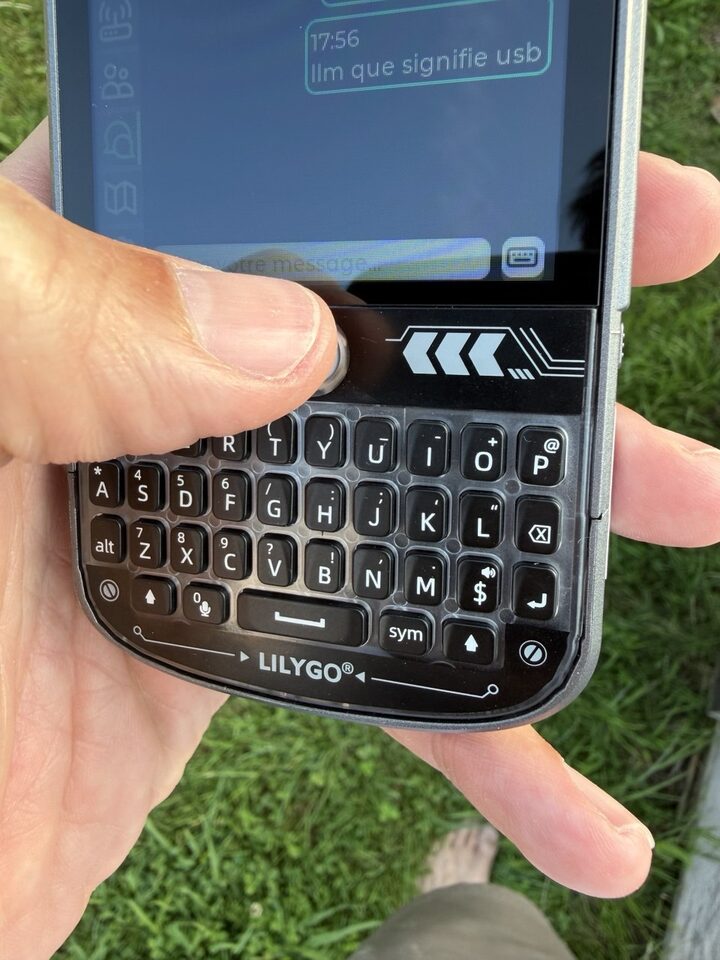
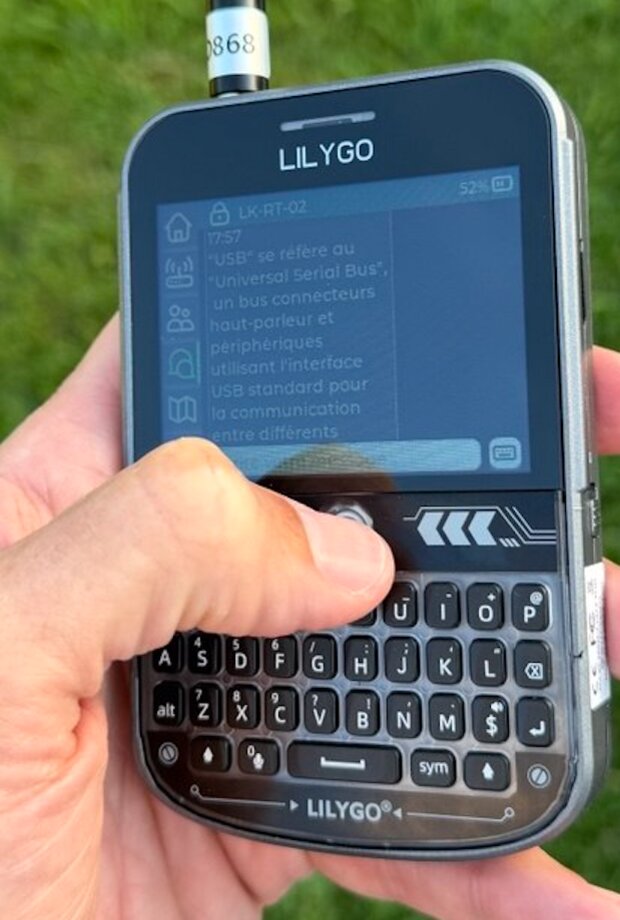
T-Deck + LarrunKonnect node + Ollama on a Raspberry Pi
A real T-Deck configured on a LarrunKonnect node can query, over LoRa, a mini Ollama LLM engine running on a plain Raspberry Pi. The result: fast access to simple information, entirely offline, with no Internet connection, from radio range anywhere on the mesh network.
LoRa: long range, low bitrate.
LoRa is a radio technology modulated to carry far with very little power. In Europe, it uses the free 868 MHz band, no licence needed, no carrier.
The trade-off is simple: to carry 10 km on a battery that lasts months, the bitrate is tiny (≈1 kbps). You send text, not video.
Mesh: every device is also a relay.
In a mesh network, there's no centre. Every node listens, and when it receives a message not addressed to it, it relays it. The message hops from node to node this way until it reaches its recipient.
From your phone to your neighbour's.
Three links, two technologies. No carrier, no central server, no SIM card.
You type the message on your phone
The Meshtastic app sends it over BLE to your local node, with no Internet connection involved.
The node transmits over LoRa, the relay forwards it
The message hops from relay to relay on the 868 MHz band, until it reaches the recipient's node.
The recipient's phone receives it
The remote node transmits over BLE to the paired phone. Notification, reading, reply.
Meshtastic: open source, mature, community-driven.
All our nodes run Meshtastic, a free firmware developed since 2019 by an international community. It handles routing, per-channel encryption, power management, and Bluetooth pairing.
A near-zero electromagnetic footprint.
This is probably the least understood difference. A LarrunKonnect node transmits at 14 dBm (≈ 25 mW) per packet, for at most a few hundred milliseconds, and stays silent the rest of the time. The duty cycle is below 1% , as required by European regulation, and largely under-used in practice.
Compared to a 4G antenna or a Wi-Fi box transmitting continuously day and night, the radio footprint of a mesh node is negligible, including for wildlife sensitive to emissions (bats, migratory birds, pollinating insects).
Low power
14 dBm (25 mW) max: equivalent to 1/800th of a mobile relay antenna.
Duty cycle < 1%
The node is in radio silence more than 99% of the time. No continuous transmission.
Sub-harmonic band
868 MHz, lower than Wi-Fi's 2.4 GHz, travels further and needs less power.
Natura 2000 compatible
The footprint is so low it fits naturally within protected areas.
LarrunKonnect versus the mobile network.
| Criterion | LarrunKonnect (LoRa Mesh) | Mobile network (4G/5G) |
|---|---|---|
| Coverage | Local (10–15 km / hop, multi-hop) | Nationwide via carrier |
| Message type | Short text, GPS position | Voice, video, unlimited data |
| Monthly cost | €0 | €10–50 depending on plan |
| Internet dependency | None | Essential |
| Power grid dependency | None (solar possible) | Carrier antennas on mains power |
| Confidentiality | AES-256 encryption per channel | Depends on the carrier |
| Range of a node | 2–15 km in line of sight | ~5 km in dense areas |
| Bitrate | ~1 kbps | 10–1000 Mbps |
| Privacy | No tracking, no SIM | Identifiable via SIM/IMSI |
Frequently asked questions.
Do I need a phone?
It's optional. A Meshtastic node can work on its own (with a screen), or be paired over Bluetooth with a smartphone for a more comfortable way to type messages.
How much does it cost?
An entry-level node costs between €25 and €60. Membership in the association is free of charge. No subscription, no plan, no recurring cost.
Is it legal?
Yes. The 868 MHz band is free to use in Europe at the power levels we use. We comply with ARCEP and ANFR regulations.
Can I use it for voice calls?
No. LoRa is a very low-bitrate text technology (~1 kbps). This is a constraint of the protocol, not a shortcoming: the low bitrate is exactly what enables the long range and low power consumption.
Is it encrypted?
Yes, by default, with AES-256 per channel. You can create private channels with your own keys.
What happens if I move further away?
As long as you're within range of at least one node in the mesh, you stay reachable. A typical single hop range is 2–15 km in clear line of sight.
Can I join from Paris / Lyon / elsewhere?
LarrunKonnect isn't an island, it's a connecting node. Even though the project is rooted on the slopes of La Rhune, it has no borders: whether you're in Ascain, Bayonne, or stranded on a ridge high in the mountains, joining LarrunKonnect means joining a sovereign mesh that ignores administrative boundaries. We don't segment the network, we extend it. There's no sign-up form here, no subscription, no restricted zone: the network is permissionless.
Does the network have an Internet connection?
By default, no: that's the whole point. An optional gateway node can set up an MQTT bridge for specific use cases (tracking, monitoring).